Can a Cavity Spread to Other Teeth? The Real Mechanism (And Why Rice, Sweets & Chai Make It Worse)
You brush twice a day. You don’t binge on candy. And yet your dentist just found a second cavity right next to the one that was filled six months ago.
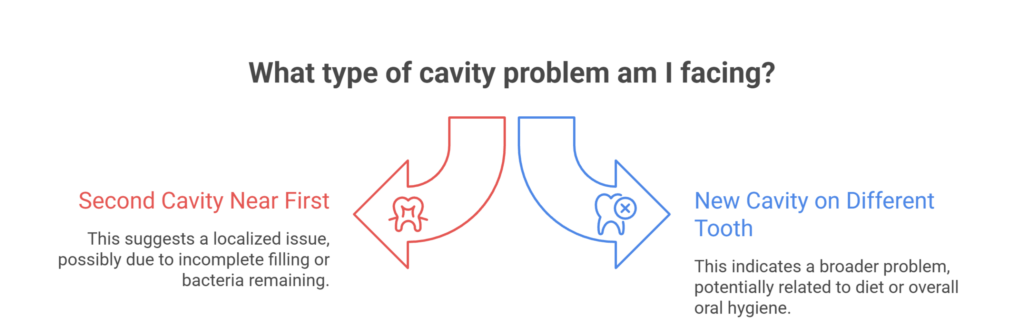
If that’s happened to you, you’re not imagining a pattern. But here’s the part most dental blogs get slightly wrong when they answer this question: that “second cavity near the first one” and “a new cavity on a completely different tooth” are not actually the same problem. They have different causes, and knowing which one you’re dealing with changes what you should actually do about it.
Let’s separate the two, and then get into why this risk runs higher on a typical Indian diet rice, tea, and traditional sweets included.
Can a Cavity Spread to Other Teeth? The Short Answer
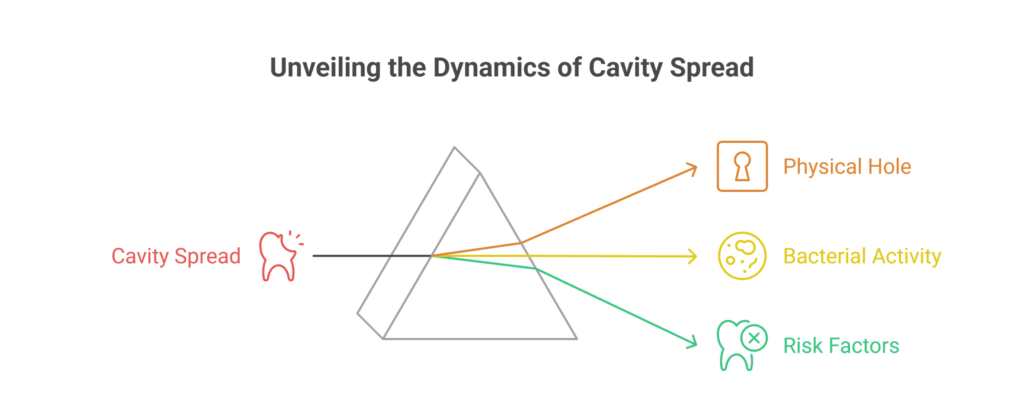
No not the way an infection spreads through a body. A cavity is a physical hole in tooth structure; it can’t travel through tissue to a different tooth.
What can spread is the cause. The bacteria and acid conditions that created the first cavity are still present in your mouth, and they’ll act on the next vulnerable surface too especially one sitting right next to it. So the honest answer isn’t “cavities don’t spread” or “cavities do spread.” It’s: the hole stays put, but the risk moves with the bacteria.
Two Different Things People Mean by "Spreading" And Why the Distinction Matters
This is the part most explanations skip, and it’s usually the actual source of confusion.
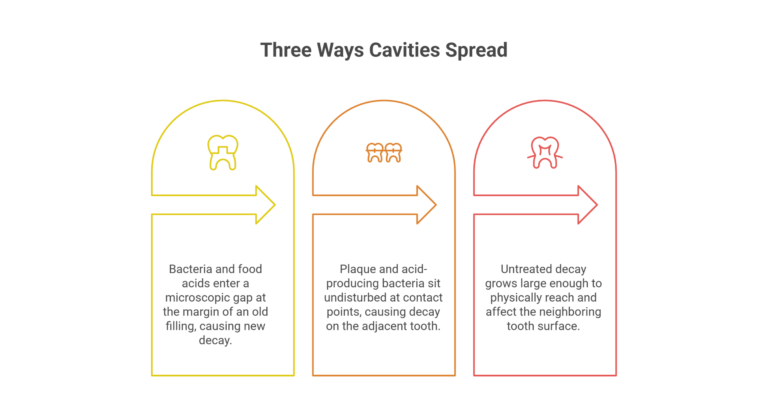
1. Secondary (recurrent) caries decay next to an existing filling When a filling ages, its edge can develop a microscopic gap against the tooth from wear, a slightly imperfect seal, or years of chewing stress. Bacteria and food acids get into that gap and start new decay right at the margin of the old filling. This is why a filled tooth sometimes needs work again years later, and why decay can appear to “return” in the exact same spot. In dentistry this is called secondary caries, and it’s one of the most common reasons old fillings eventually need replacing.
2. New decay on a neighboring tooth the shared bacterial environment This is the scenario most people actually mean when they ask if a cavity “spreads.” At contact points where two teeth touch plaque and acid-producing bacteria sit undisturbed if flossing is inconsistent. A cavity on one tooth is really a sign that the bacterial and acid environment in that part of your mouth currently favors decay. If nothing about diet or cleaning technique changes, the tooth touching it is sitting in the same environment and is next in line.
3. Direct extension at the contact point (advanced, untreated cases) If decay on one tooth is left untreated long enough, it can grow large enough to physically reach the neighboring tooth’s surface at the point where they touch. At this stage both teeth typically need treatment together this is genuinely rare compared to the first two mechanisms, but it’s the scenario people picture when they imagine a cavity “jumping.”
Knowing which of these three you’re dealing with is exactly what an X-ray is for visually, a new small cavity next to a filling and a cavity extending from one tooth into the next can look similar to the naked eye but need different treatment planning.
How Cavity-Causing Bacteria Actually Move Around Your Mouth
Streptococcus mutans is the primary bacteria responsible for tooth decay it metabolizes sugars and starches and releases acid as a byproduct, which is what demineralizes enamel over time. Three everyday mechanisms let that risk spread beyond a single tooth:
- Bacterial transfer at contact points. Most back teeth touch their neighbors directly. Plaque and bacteria move freely across that shared surface, so a heavily colonized area on one tooth is effectively colonizing the one next to it too.
- Compensatory chewing changes your risk map. Once a tooth becomes sensitive, most people unconsciously shift chewing to the other side of the mouth. That shifts food debris and plaque buildup toward teeth that were previously in better shape you’re not protecting the sore tooth by avoiding it, you’re quietly overloading a different one.
- Neglect compounds. Pain or sensitivity in one area often leads to gentler, less thorough brushing around it, which lets plaque build up in exactly the spot that most needs cleaning.
Why This Risk Is Higher on a Typical Indian Diet
This is the part most generic dental content almost all of it written for a US audience eating very differently doesn’t address at all, and it’s the single biggest modifiable factor for a lot of Indian patients.
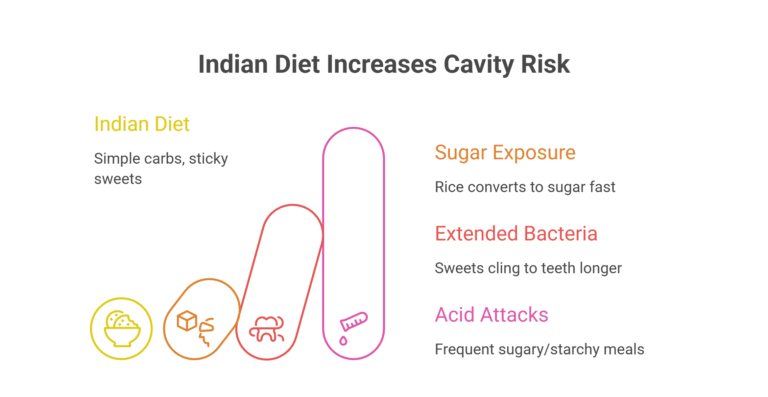
Rice converts to sugar fast. Rice is a simple carbohydrate; salivary enzymes start breaking it down into fermentable sugars almost immediately in the mouth. A plate of rice sitting through a slow lunch behaves, chemically, closer to sustained sugar exposure than most people assume.
Traditional sweets are sticky, not just sugary. Ladoo, barfi, and gulab jamun cling to grooves and interdental spaces far longer than a quick snack would, extending the window bacteria have to produce acid from minutes to hours.
Frequency matters more than quantity. Each time you eat something sugary or starchy, your mouth stays acidic for roughly 20–30 minutes afterward. Chai after breakfast, rice at lunch, a sweet after dinner, and chai again in the evening adds up to four or five separate acid attacks a day, every day and it’s the frequency of these cycles, not the total amount eaten, that drives decay risk.
The numbers back this up at a population level: India’s National Oral Health Survey found roughly 50% caries prevalence in 5-year-olds, and a separate multi-state survey by the Ministry of Health and Family Welfare with the WHO recorded caries prevalence as high as 67.8% among the age groups studied with a high proportion of that decay left untreated. None of this means giving up rice or sweets. It means a mouth exposed to this eating pattern daily needs a correspondingly stronger defense: better interdental cleaning, the right toothpaste, and checkups that catch decay before it spreads rather than after.
[Clinical note — for Dr. Tania to verify/personalize]: This is a good spot for a first-person observation from your own patient base — e.g., how often you see secondary caries at old filling margins in patients with a rice-and-chai routine, or a specific pattern you’ve noticed with Vasant Vihar patients. Flagging this block so you can confirm accuracy or add a real example before publishing.
Early Signs a Cavity Might Be Spreading
Watch for these together, not in isolation:
- New sensitivity to hot or cold in a tooth next to one already treated
- A dull ache specifically when chewing on one side
- Visible dark spots or a rough patch between two adjacent teeth
- Food consistently trapping in the same spot no matter how carefully you floss
- Bad breath that doesn’t resolve with brushing
If two or more of these show up together, it’s worth getting an X-ray rather than waiting for pain to force the decision interproximal decay (between teeth) is frequently invisible to the eye until it’s advanced.
What Happens If You Ignore It
Untreated decay typically moves through a predictable sequence:
- Enamel decay — usually painless, quick and inexpensive to fix
- Dentin decay — mild sensitivity, still a straightforward filling
- Decay reaching the nerve (pulp) — real pain, usually needs a root canal
- Infection or abscess — swelling, risk of tooth loss
Stages 1 and 2 are the cheap, fast ones. Stages 3 and 4 cost more, take longer, and are avoidable in nearly every case with earlier intervention.
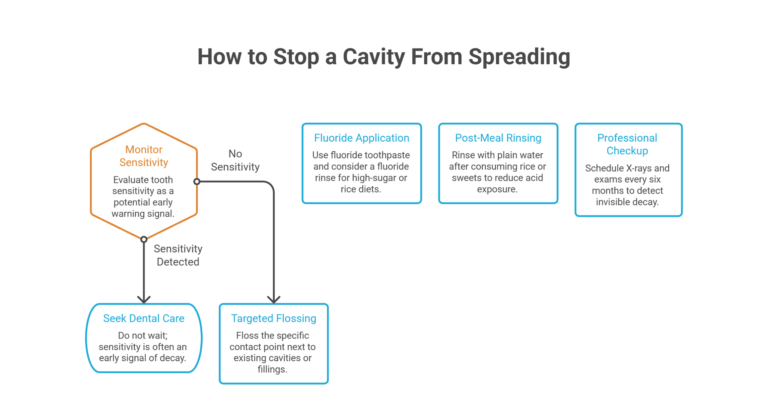
How to Actually Stop a Cavity From Spreading
- Floss the specific contact point next to any existing cavity or filling – not just your general routine. This exact spot is where bacterial transfer happens.
- Use a fluoride toothpaste, and consider a fluoride rinse if rice or sweets are a daily part of your diet. Fluoride actively helps reharden enamel that’s been weakened but hasn’t broken down into a full cavity yet.
- Rinse with plain water after rice-heavy meals or sweets, even when brushing isn’t possible. This alone meaningfully cuts down acid exposure time.
- Get a checkup and X-ray every six months, not just when something hurts. Early interproximal decay is invisible to you and obvious on imaging.
- Don’t wait out sensitivity. It’s rarely just sensitivity it’s often the earliest signal you’ll get.
Treatment Options, Depending on What's Actually Happening
-
- Fillings for early to moderate decay on one or more teeth
- Inlays/onlays when the cavity is too large for a standard filling but the tooth structure is still largely intact
- Root canal treatment if decay has reached the nerve Crowns to protect a tooth significantly weakened by decay
- Replacement of an old filling if the issue is secondary caries at the margin, rather than a new lesion
The right option depends entirely on which of the three mechanisms above is actually happening which is exactly why an X-ray-first diagnosis matters more than guessing from symptoms.
Frequently Asked Questions
Is a cavity next to an old filling the same as a cavity "spreading"?
Not quite. That’s typically secondary caries new decay forming at a small gap in the filling’s margin rather than decay traveling from one tooth to another. The fix is usually replacing the filling, not just treating it as a fresh, unrelated cavity.
Can a cavity spread to a tooth on the opposite side of the mouth?
No spreading risk is almost always local, between touching or neighboring teeth, since that’s where bacteria and plaque physically transfer. A cavity on your lower-left molar doesn’t raise your risk on the upper-right side in any direct way.
If I get one cavity filled, will the tooth next to it definitely get a cavity too?
Not definitely, but the risk is higher than average especially if the underlying cause (diet frequency, brushing technique, flossing at that specific contact point) hasn’t changed. This is why dentists recommend rechecking neighboring teeth closely after any filling.
Is rice really as risky as sugar for cavities?
In terms of acid production, yes rice converts to fermentable sugar quickly once it hits saliva. The difference is that rice is eaten daily as a dietary staple rather than occasionally, which is what makes the cumulative exposure higher than most people assume.
Does a cavity spread through saliva to other people?
Cavity causing bacteria can theoretically transfer through shared utensils or very close, repeated contact, but this isn’t a meaningful way cavities spread within your own mouth, and it’s not something to worry about in normal daily life.
When to Seek a Diagnostic Evaluation
If you are noticing any of these warning signs, guessing based on surface symptoms usually leads to delayed care. Because secondary caries, interproximal decay, and direct extension can look identical to the naked eye, visual inspection alone isn’t enough to guide treatment.
At Udana Wellness in Vasant Vihar, our approach for patients with recurring decay always begins with targeted digital imaging. Before restoring a tooth, we map the exact underlying mechanism identifying whether you are dealing with a failing filling margin, active bacterial transfer between teeth, or an isolated issue.
For patients in South Delhi navigating high-frequency dietary factors like daily chai or rice, managing cavity risk requires more than basic fillings. It requires addressing the underlying bacterial environment, cleaning habits, and interdental protection before small issues turn into complex procedures.
If you’re experiencing localized sensitivity or suspect a cavity is returning, schedule a comprehensive digital evaluation at our Vasant Vihar clinic before pain forces an emergency visit.

Dr. Tania Nijhwan
Dr. Tania Nijhawan, BDS, MDS, is a leading Cosmetic and Aesthetic Dentist in Vasant Vihar, New Delhi, and the Founder of Udana Wellness. She has completed advanced training in Smile Designing at New York University (NYU) and Implantology at the University of Southern California (USC).
With a strong focus on preventive, restorative, and cosmetic dentistry, Dr. Tania specializes in smile makeovers, dental implants, veneers, clear aligners, teeth whitening, and comprehensive oral care. She believes that dentistry is about more than treating teeth, it's about improving confidence, health, and quality of life.
Known for her compassionate approach and attention to detail, Dr. Tania is committed to delivering evidence-based, patient-centric dental care in a comfortable and trusted environment at Udana Wellness.